
Coffee is Sweet
Menu
Curated Equipment & Bean Rescue

Curated Gear Guide & Grocery Bean Rescue

You do not need 500 dollars of machinery to brew sweet, cafe-quality coffee. We cut through retail marketing with 3 honest gear tiers, side-by-side trade-offs, and an emergency rescue protocol for cheap supermarket dark roasts.

Three Honest Equipment Tiers

Every tier has clear strengths and blunt trade-offs. Choose the setup that fits your daily routine rather than commercial hype.

< $50Estimated Total: ~$48 USD

The Essential Starter

Freshly ground specialty coffee for less than the cost of a dinner date.

Ideal For: Beginners transitioning from supermarket pre-ground or pods who want real freshness on a tight budget.
  • Genuine steel burr grinder replaces bitter blade whirlyblades
  • Plastic V60 retains heat better than ceramic or glass
  • Uses standard kitchen items you already own
Compact entry-level coffee setup with manual hand grinder, plastic V60 dripper, and kitchen scale
1. The Grinder$30 - $35

KINGrinder P0 or Timemore Chestnut C2 (Refurbished/Sale)

Why It is Picked:

High-carbon stainless steel burrs produce uniform grind particles with 80% fewer fines than cheap ceramic burrs.

Honest Trade-off:

Smaller 20g capacity hopper, internal click adjustment dial, slower grind speed for dense light roasts.

2. The Brewer$9 - $14 (V60) / $35 (AeroPress)

Hario V60 Plastic 02 or AeroPress Original

Why It is Picked:

Plastic has ultra-low thermal mass (stealing zero heat from your water) and is virtually shatterproof for lifetime durability.

Honest Trade-off:

Requires regular paper filter restocks; V60 requires a steady pouring hand without a gooseneck spout.

3. Kettle & Scale$10 - $12

Standard Kitchen Digital Scale (0.1g) + Any Standard Boiling Kettle

Why It is Picked:

Measuring beans and water gram-for-gram instantly eliminates 90% of bad sour/bitter cups. Gentle center pouring works great without a gooseneck.

Honest Trade-off:

Standard kitchen scales have slight 0.5s display lag; standard kettles lack flow-restrictor gooseneck spouts.

Kitchen Extraction Science

Supermarket Dark Roast Extraction Rescue

Bought a cheap grocery bag that smells like burnt campfire and ash? Do not trash it. Supermarket dark roasts fracture easily and dissolve quickly. By adjusting five physical extraction variables, you can suppress harsh quinic acids and isolate rich caramel, molasses, and chocolate sweetness.

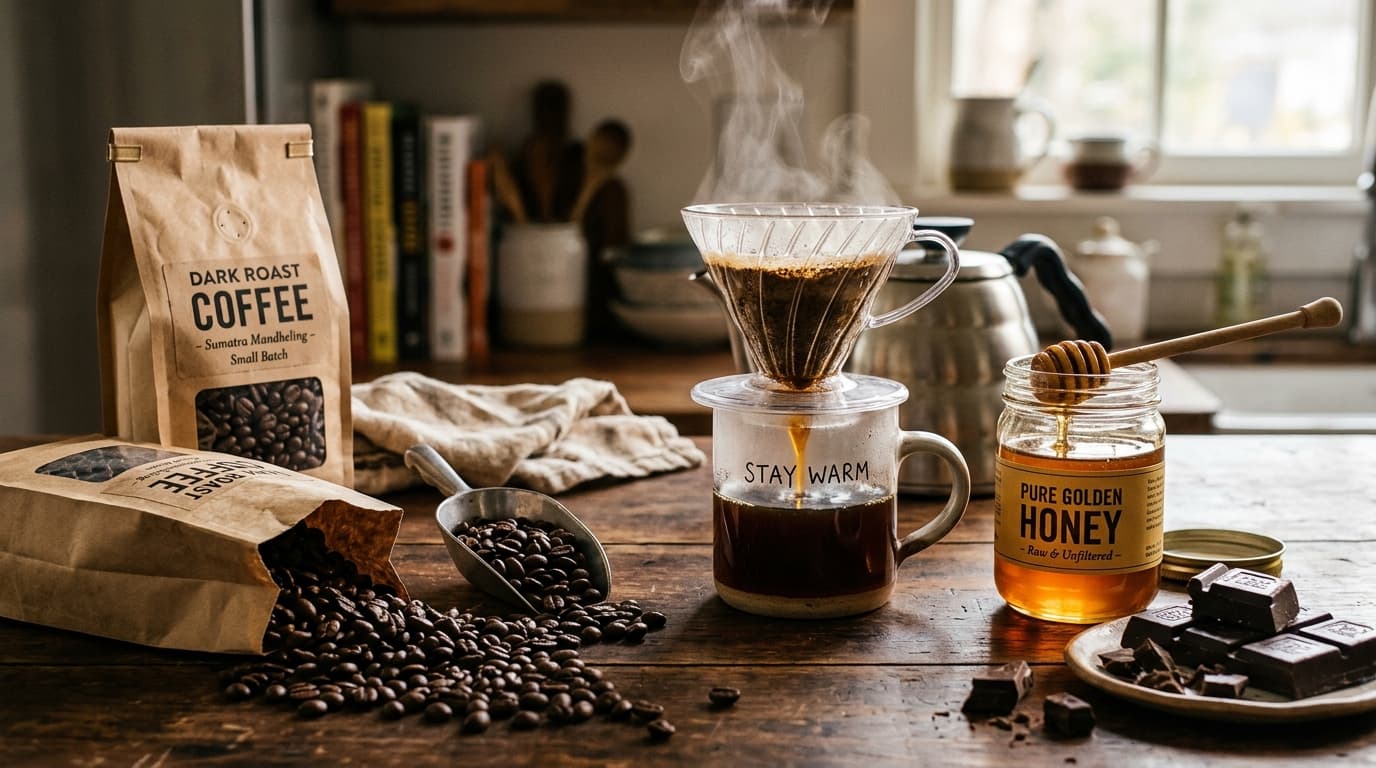
Grocery dark roast bean rescue brewing with honey and caramel notes

Interactive Kitchen Rescue Checklist

Check off each step as you prepare your brew to dial in sweet flavors.

Rescue Applied

0 of 5 steps (0%)

180°C - 85°C (176°F - 185°F)

Drop Water Temperature to 80°C - 85°C (176°F - 185°F)

Never pour boiling 100°C water onto dark supermarket beans. Boil your kettle, take the lid off, and let it cool for 3 to 4 minutes (or add 10% room-temperature water) to reach 82°C-85°C before brewing.

The Extraction Science:

Dark roasting fractures bean cell walls and breaks down chlorogenic acids into harsh bitter lactones and phenylindanes. Lower water temperature drastically reduces the solubility of these bitter compounds while preserving pleasant caramel and chocolate oils.

Pro Tip: If you have no thermometer, boil the kettle, open the lid, and count to 200 before pouring.
2Coarse Sand / Kosher Salt

Grind Noticeably Coarser (Coarse Sea Salt Texture)

Set your grinder 3 to 5 clicks coarser than your normal pour-over setting. Particles should look like kosher salt or coarse beach sand, not fine table salt.

The Extraction Science:

Dark roasted beans are physically brittle and produce an immense quantity of microscopic fines when ground. A coarser setting minimizes total surface area exposure and prevents fines from clogging the filter bed.

Pro Tip: If your drawdown stalls past 2:30, immediately click 2 steps coarser for your next brew.
3Low height center pour, < 2:15 total contact time

Speed Up Water Flow & Eliminate Bed Agitation

Pour gently in low-height center circles. Avoid aggressive swirling, stirring, or pouring from high above the brewer which violently churns the grounds.

The Extraction Science:

Heavy turbulence drives microscopic dark fines deep into filter paper pores, choking water drainage and forcing bitter over-extracted compounds into your cup.

Pro Tip: Keep the kettle spout just 1.5 to 2 inches above the water surface to pour smoothly without splashing.
41:13 brew ratio + 15-20% clean bypass water in cup

The 1:13 Bypass Brewing Technique (The Secret Weapon)

Brew a concentrated base using only 1:13 ratio (e.g., 20g coffee to 260ml hot water). Remove the brewer as soon as the main stream slows down, and immediately add 40ml-60ml of clean, hot water directly into your mug.

The Extraction Science:

The first 60% of brew water dissolves 90% of desirable sugars, lipids, and sweetness. The final 40% of water extracts nothing but harsh tannins, ash, and astringency. Stopping early and diluting with pure water gives a rich, velvety cup completely devoid of throat-drying bitterness.

Pro Tip: This single trick turns $8 grocery store dark roasts into silky, comforting diner-style morning brew.
51:7.5 brew ratio, 16-18h refrigerated steep

Cold Brew Immersion (Zero Heat Extraction for Harsh Beans)

For heavily charred or stale beans that resist all hot brewing, steep 100g of coarse grounds in 750ml cold filtered water in a mason jar in the fridge for 16 to 18 hours. Filter through paper or cheesecloth.

The Extraction Science:

Cold water lacks the thermal energy required to dissolve harsh quinic acids, caffeine salts, and burnt wood lignin. The resulting concentrate retains only sweet cocoa, molasses, and chocolate notes.

Pro Tip: Serve 1:1 diluted over ice with cold water or creamy oat milk for a naturally sweet iced drink.

Live Kitchen Rescue Calculator

Scale your exact dry coffee grams to get the precise brew water, bypass water, and temperature.

Target Temperature: 82°C - 85°C (180°F - 185°F)

Grind Texture: Coarse kosher salt texture (3-5 clicks coarser than normal pour-over)

Pour Schedule: 1:45 - 2:15 (stop early, do not let bitter tail drain)

Brew Blueprint (1:13 concentrate + 18% bypass)
1. Kettle Water in Cone260 mlat 82°C to 85°C
2. Clean Bypass in Mug+47 mlclean fresh water
Final Cup Yield:307 ml
Bag Truth vs Marketing Hype

Shelf Decrypter & Buzzword Decoder

Translate marketing buzzwords into actual agronomic facts so you always get fresh beans.

Signal Category: Freshness & Roast Date
✓ Good Signal:Explicit "Roasted On" Date

"Roasted on Oct 14, 2026"

Indicates transparency and freshly roasted beans, ideally brewed within 2 to 6 weeks of roasting.

✗ Red Flag:Vague "Best Before" or "Expiry" Date

"Best Before: Dec 2028" (18-24 months out)

Supermarket trick to mask old inventory. Coffee stales after 6-8 weeks; an expiry date tells you nothing about roast freshness.

Why it matters: Oxygen and moisture turn coffee oils rancid over time. An exact roast date is the #1 predictor of whether your cup will taste sweet or flat cardboard.

Signal Category: Origin & Terroir Traceability
✓ Good Signal:Specific Origin, Region, or Washing Station

"Huila, Colombia, Finca El Paraíso, 1,750m"

Specific regions and farm names show direct supply chain traceability and high-grade specialty sorting.

✗ Red Flag:Generic Continent / Global Blend

"Premium South American Blend" or "European Roast"

Vague blend labels usually combine cheap commodity surplus lots from multiple years to hit the lowest wholesale price point.

Why it matters: Single-origin transparency means the bean was harvested for flavor terroir rather than bulk commodity volume.

Signal Category: Processing Method Disclosure
✓ Good Signal:Clearly Stated Processing Method

"Washed", "Natural / Sun-Dried", or "Honey Process"

The post-harvest method defines 50% of the flavor profile (washed = clean, sparkling; natural = jammy, sweet fruit).

✗ Red Flag:Total Omission of Processing Method

Filled with buzzwords: "Master Select", "Artisan Roasted"

If a roaster doesn’t know or state how the coffee was processed, it is almost certainly commercial bulk commodity.

Why it matters: Processing dictates whether your beans will brew bright and floral or heavy and chocolatey. Good roasters always specify it.

Signal Category: Roast Degree vs "Intensity"
✓ Good Signal:Descriptive Flavor & Roast Degree

"Light-Medium: Peach, Honey, Black Tea" or "Medium: Milk Chocolate, Toasted Pecan"

Focuses on natural bean flavors and gentle heat application to showcase sweetness.

✗ Red Flag:"Intensity 10/10" or "Extra Dark Italian"

"Maximum Intensity 12" / "Dark Bold Roast"

"Intensity" is a commercial euphemism for how burnt and charred the beans are, not caffeine potency or quality.

Why it matters: Heavily burnt beans taste identical regardless of origin because roasting heat destroyed all organic sugars.

qualityClaim

100% Arabica

Marketing: Suggests the beans are premium, elite, and superior to all other coffees.

Plain Truth:

Arabica is simply the biological species (making up 60% of all global coffee). Low-grade commodity Arabica can still be insect-damaged, unripe, or stale.

roastClaim

French Roast / Italian Roast

Marketing: Sounds sophisticated and Parisian, evoking European cafe romance.

Plain Truth:

Beans roasted past "second crack" until surface oils oxidize and bean cellulose chars. The taste is pure smoke, ash, and carbon with zero origin sweetness.

roastClaim

Intensity 10 / 12 / Extra Bold

Marketing: Implies maximum energy, high caffeine, or rich artisanal strength.

Plain Truth:

"Intensity" scales measure roast darkness and burnt bitterness, NOT caffeine content. Light roasts actually have slightly more caffeine by mass than dark roasts.

labelClaim

Gourmet / Artisan / Master Blend

Marketing: Suggests hand-crafted micro-batches blended by master sommeliers.

Plain Truth:

Legally unregulated buzzwords placed on bags by marketing agencies without any official third-party quality standard or grading requirement.

originClaim

High Altitude / Mountain Grown

Marketing: Grown on mystical mountain peaks for superior flavor.

Plain Truth:

High altitude (1,200m - 2,000m+) genuinely slows cherry ripening, producing denser beans with more complex sugars, but only if exact elevation numbers are printed.

originClaim

Direct Trade / Fairly Sourced

Marketing: Promises the farmer received double the market price without middlemen.

Plain Truth:

Unless backed by verifiable sourcing reports, named producer cooperatives, or certified transparency portals, "direct trade" is frequently used without legal accountability.